School Club Sublimation Polos: Using Collar Contrast Without Crowding Artwork
A school club uniform often needs to display a badge, school colours and perhaps a sponsor or activity motif on a small garment. The collar is a useful design boundary: it can organise the overall appearance or make an already busy shirt feel cluttered. This guide focuses on using contrast and print continuity deliberately, especially when several student sizes share the same design.
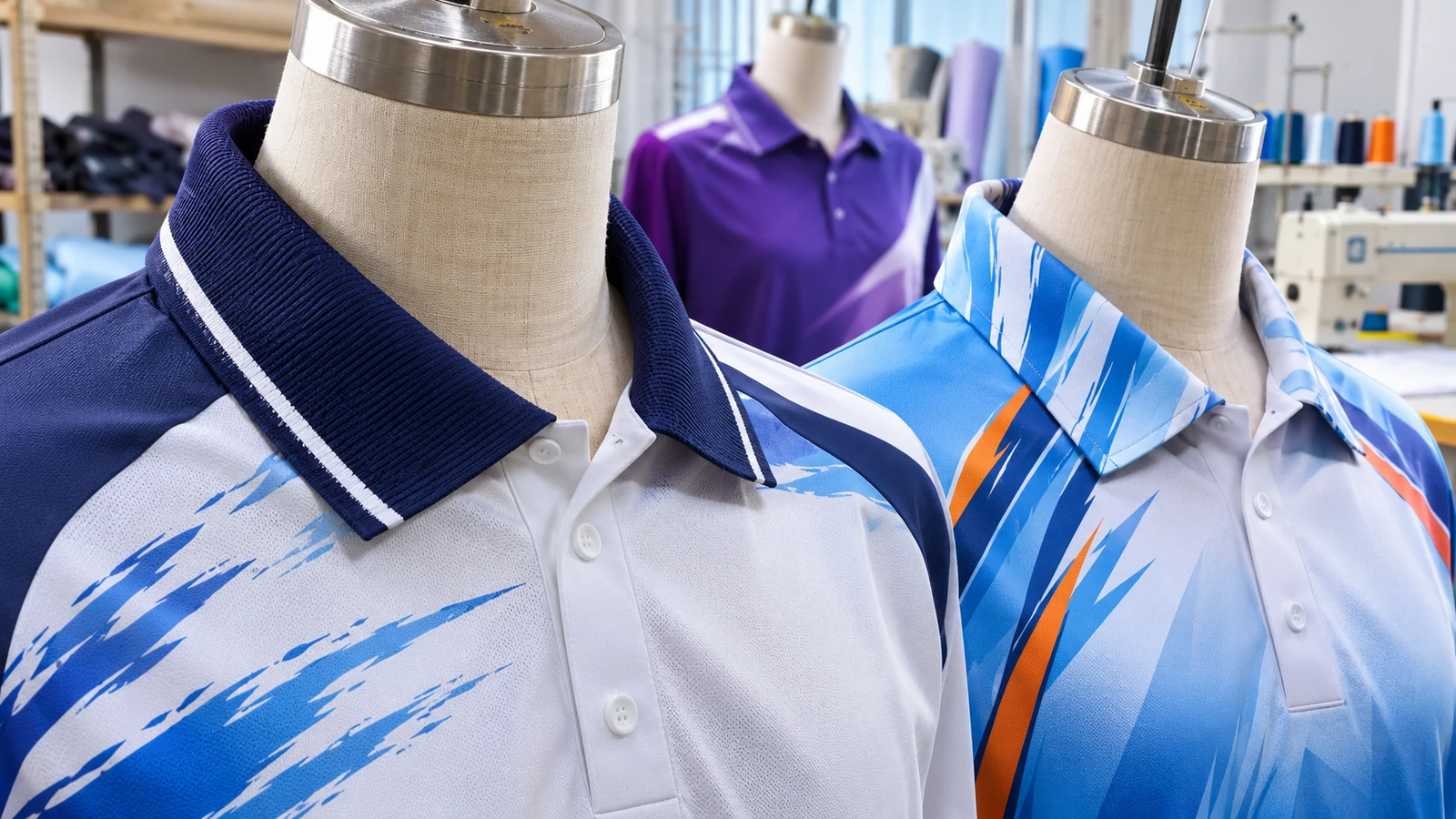
Choose a clear visual hierarchy first
Decide which mark must be read first when the polo is worn: school identity, club title or sponsor. A small chest badge and a calm collar often work better than several equally loud patterns. Write down approved colours and acceptable contrast combinations before selecting a collar material. That reduces late changes once panel printing is prepared.
For the purchase approval, review a photograph of the mockup at normal viewing size, not zoomed in. This is worth recording before the design is signed off, because too many competing coloured zones can make the identity difficult to recognise.
Use contrasting collars with a purpose
A dark solid collar can frame a brightly printed body; a light collar can work when the garment is otherwise dark. Contrast should be evaluated against neck opening, buttons and printed shoulder panels. A ribbed collar may be supplied in fixed colours, while a self-fabric collar may permit planned sublimation depending on construction.
A useful verification step is to compare at least two real collar combinations against the same printed body fabric. The practical reason for that check is that choosing a collar from a screen swatch can produce unexpected brightness or texture.
Keep fine patterns away from complicated seams
Motifs crossing shoulders and neckline seams can misalign when printed fabric is cut and sewn. Tiny repeated lines may look jagged if they meet at different angles. For school clothing, a clean transition can be more robust than expecting perfect pattern continuity through a folding collar. Establish safe zones for logos and text near seam allowances.
During the production review, mark collar, placket and shoulder seam positions on the final artwork template. Skipping this step can cause a surprisingly expensive problem: a digital flat view may conceal visual interruptions created during sewing.
Plan student sizes without shrinking the badge too far
A single emblem sized for adult shirts may overwhelm a youth chest panel. Conversely, automatically shrinking every detail can make text unreadable. Define proportional placement rules by size range and approve at least one smaller sample. Check how the logo sits when the polo is buttoned and when a lanyard is worn.
The team should also test the smallest planned size with the real finished collar and badge. Treat this as part of the specification rather than an informal preference, since poor grading may force the badge into the armhole or underneath a fold.
Proof fabric colours after sublimation
A design on a screen is only a preview. Fabric weight, polyester construction, ink transfer and heat settings can shift perceived colour. Ask for a printed sample on the intended material and inspect it after the garment is sewn. Where two different collar materials are used, expect differences in texture and appearance even when their shades are similar.
Before a supplier prepares the final proof, keep a fabric-and-collar sample pinned to the final signed artwork. The risk is operational as much as visual: a mismatch discovered after a full school order is expensive to correct.
Manage the order through one approved brief
Record the club name, artwork master, shirt cut, collar type, size range, quantity and delivery location. Split optional student names or house colours into controlled variants. Uniform Sabah offers sublimation and other apparel production through remote supply; confirm available fabric and construction for the actual order rather than assuming any mockup is automatically manufacturable.
For a repeat order, obtain sign-off from the school contact before preparing final production files. Keep the result with the approved sample, since separate informal design requests can create inconsistent versions within one batch.
Practical example: making the decision
A school club is deciding between a bright printed polo with a matching patterned collar and the same body with a dark solid collar. The patterned option looks striking in a large digital mockup, but the pattern becomes visually busy around the placket of the smallest student size. The team prints a sample using the intended polyester material and compares it with the calm dark collar. They also check whether the school badge remains legible under normal room lighting. The approved design defines the badge size separately for youth and adult patterns and records the collar construction rather than only its colour. When the school requests additional sizes, the supplier can refer to the signed master artwork and garment sample. The example is a design-decision exercise, not a guarantee about one particular collar's availability.
Additional approval considerations
Students may wear the same club polo at meetings, competitions and group photographs. A visually energetic design needs enough calm space for the school emblem to remain the first recognisable mark. Before approval, view the design alongside real backpacks, badges or lanyards, which can cover parts of the chest. The outfit should still communicate identity.
A school order may include groups whose shirt colours differ by house or year. Instead of creating unrelated artwork each time, maintain a controlled colour and placement system. Name the variants explicitly in the final order and verify totals per version, so the factory does not have to infer which printed collar belongs to which student group.
- Review a photograph of the mockup at normal viewing size, not zoomed in.
- Compare at least two real collar combinations against the same printed body fabric.
- Mark collar, placket and shoulder seam positions on the final artwork template.
- Test the smallest planned size with the real finished collar and badge.
- Keep a fabric-and-collar sample pinned to the final signed artwork.
- Obtain sign-off from the school contact before preparing final production files.
Frequently asked questions
Is a printed self-fabric collar always available?
It depends on construction and production method; confirm during quotation.
Can a single design serve all student sizes?
Yes with size-aware placement and suitable garment patterns, subject to sample approval.
Does sublimation work on cotton?
Standard dye sublimation is intended for appropriate polyester substrates; confirm the selected fabric.
What proof should the school approve?
A sewn sample with final collar, badge, fabric and size-aware placement.
For a quotation based on the actual garment, print method, quantity and delivery location, review UniformSabah services and use the official enquiry page. Prices, methods, production schedules and minimum quantities must be confirmed for the specific job.