Sandakan Souvenir Stickers: Planning Label Sheets and Delivery from West Malaysia
Souvenir retailers and small brands in Sandakan may want stickers for gift packs, product boxes or seasonal collections. The printing decision is not only whether a label should be round or die-cut. The supplier needs to know the packaging surface, cut format, number of designs and how sheets will be packed for delivery. When sourcing from a West Malaysia provider, proofing and freight planning can prevent avoidable errors before goods arrive in Sabah.
Identify whether the sticker is decoration or information
A decorative souvenir badge can use a different material and layout from an ingredient, manufacturer or handling label. If information is legally required, confirm it through the applicable product rules rather than treating a design mockup as compliant. Decide the minimum readable size, preferred shape and available surface on the real package.
For the purchase approval, separate decorative artwork from any regulated product information before ordering. This is worth recording before the design is signed off, because a beautiful label can still be unsuitable if essential information becomes too small.
Choose sheets or individuals by fulfilment method
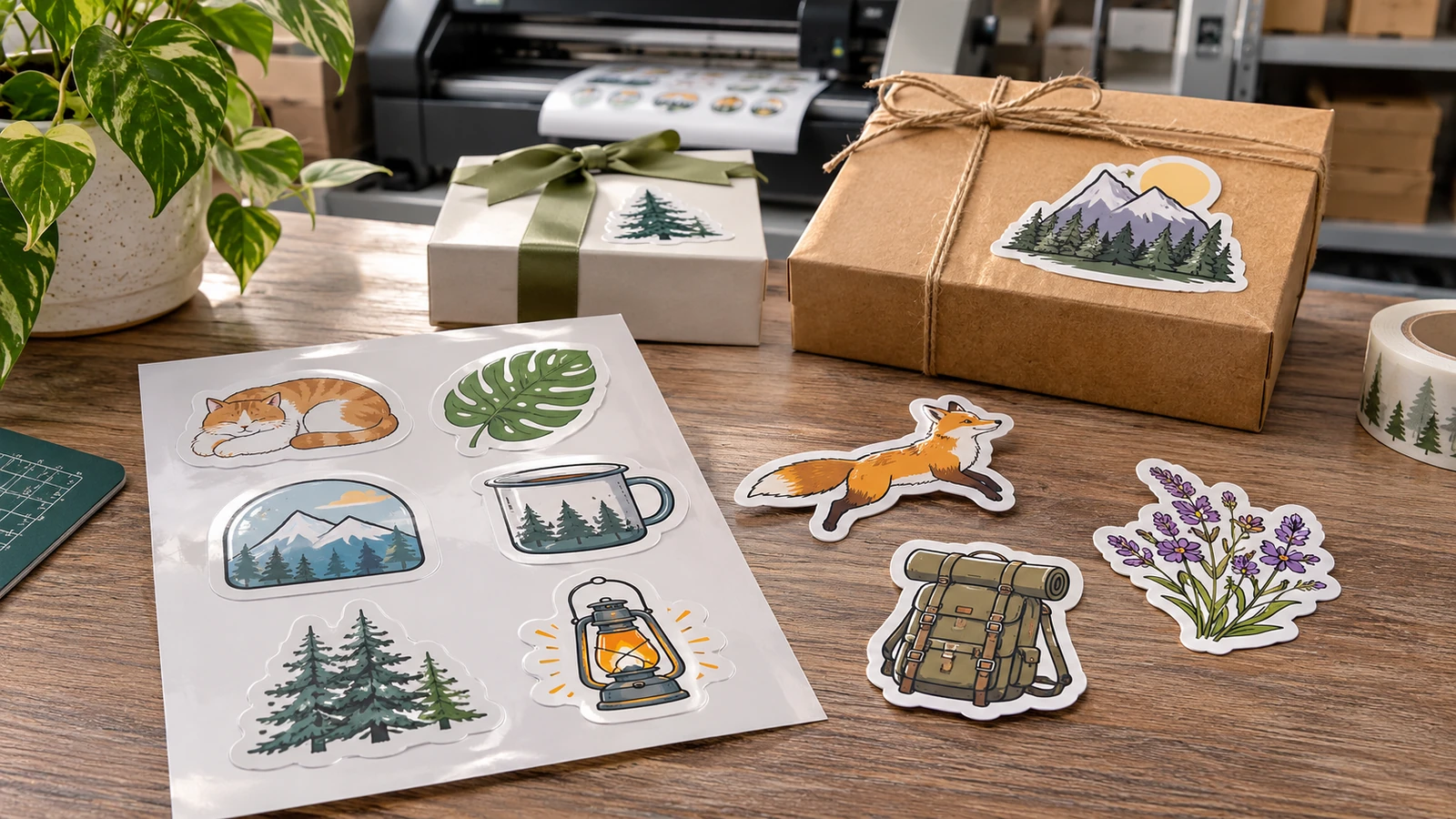
Kiss-cut sheets allow staff to peel labels from a backing sheet, while individual contour-cut pieces may work for giveaways or included extras. Decide how many designs belong on each sheet, how many pieces are needed per product and whether packing workers will peel labels by hand. A multi-design assortment can be useful but increases picking risk.
A useful verification step is to have a worker test a small sheet with the actual packaging workflow. The practical reason for that check is that a cut path that is difficult to peel slows packing and wastes labels.
Match adhesive and finish to souvenir packaging
Paper bags, clear plastic, glass jars and laminated boxes do not behave as the same substrate. Exposure to humidity, repeated handling or refrigeration may change the result. Explain the intended surface to the printer and request a trial with the actual label stock. A water-resistant face material does not automatically mean the adhesive will suit every wet surface.
During the production review, stick sample labels onto the final clean package and monitor edges over time. Skipping this step can cause a surprisingly expensive problem: testing only on smooth office paper can hide later lifting on textured stock.
Keep cut lines and design margins realistic
Complicated shapes can be attractive in artwork but fragile in handling. Thin projections, tiny interior cuts and small type near the edge need production review. Provide vector artwork where possible and use a separate cut path according to the printer’s specification. Confirm whether the finished sticker or the liner will have rounded or shaped corners.
The team should also approve a close-up image and one physical sample of the cut edge. Treat this as part of the specification rather than an informal preference, since the most detailed outline is not always the most durable packaging choice.
Protect labels during inter-state transport
Stickers may arrive as loose sheets, bundled packs or individually counted pieces. Ask how liners will be protected against bending, moisture and heavy parcels. Put the design name, colour variant and quantity on each pack so the receiver can check without opening every bundle. Confirm whether delivery charges, damaged-parcel procedures and split shipments are part of the quote.
Before a supplier prepares the final proof, request a packing list and photograph cartons immediately on receipt. The risk is operational as much as visual: a crushed liner stack can make otherwise correctly printed labels difficult to use.
Create a reorder file that works remotely
Keep the exact artwork, size, stock, finish, adhesive and cut format with the dated approved proof. Record the previous pack configuration and Sandakan delivery postcode. Before repeating a print run, ask whether the material or cutting method has changed. Clear documentation avoids relying on informal photographs and memory.
For a repeat order, assign one person to approve the final proof and receive the delivered goods. Keep the result with the approved sample, since without a frozen specification, a second order may not match the first.
Practical example: making the decision
A Sandakan souvenir seller wants a tropical-themed sticker on paper gift bags, clear bottles and cardboard boxes. A single adhesive and finish is initially assumed suitable for every package, but a test shows that the kraft bag's textured surface behaves differently from smooth plastic. The seller chooses a limited number of materials with supplier guidance instead of using an unverified universal claim. Stickers are grouped into labelled sheets so staff can identify the correct design quickly. The cut line is simplified where small points tear during peeling. Before delivery from West Malaysia, the supplier is asked to protect liners from bends and include a pack-by-design count. On arrival, the seller checks one bundle of each design and saves the approved proof, making a later remote reorder possible without reconstructing the artwork from memory.
Additional approval considerations
Packing labels for souvenir gifts often need to survive handling by visitors who travel with them. A label on a paper bag may rub against other bags, while a sticker on a bottle may be exposed to moisture. These are distinct tests: a single attractive proof cannot demonstrate both. Ask the supplier to separate material options by intended use.
A remote order also benefits from clear carton identification. If ten similar designs arrive together, mark each bundle with the approved design code and quantity. Inspect a few pieces from the top, middle and bottom of the stack. That method can reveal damage or mix-ups before a seasonal sales rush starts.
- Separate decorative artwork from any regulated product information before ordering.
- Have a worker test a small sheet with the actual packaging workflow.
- Stick sample labels onto the final clean package and monitor edges over time.
- Approve a close-up image and one physical sample of the cut edge.
- Request a packing list and photograph cartons immediately on receipt.
- Assign one person to approve the final proof and receive the delivered goods.
Frequently asked questions
Are die-cut stickers better than kiss-cut sheets?
Neither is universally better; choose by handling and distribution.
Can all stickers tolerate chilled storage?
No. Adhesive, face stock and application temperature require specific testing.
Does Uniform Sabah have a Sandakan pickup point?
Do not assume one; published service is supplied via Selangor with Sabah delivery arrangements.
What goes into the quotation request?
Dimensions, quantity, substrate, finish, design variants, cut path and destination postcode.
For a quotation based on the actual garment, print method, quantity and delivery location, review UniformSabah services and use the official enquiry page. Prices, methods, production schedules and minimum quantities must be confirmed for the specific job.