Can You Use Bleach on T-Shirts?
Bleach can help whiten, brighten or remove certain stains, but the wrong bleach can also fade colours, weaken unsuitable fibres and damage printed or decorated shirts. The safest answer depends on the care label, fabric, shirt colour and the type of bleach being used.
Can you use bleach on a T-shirt?
Sometimes. Chlorine bleach is mainly suited to garments whose care labels permit it and whose fibres and colours are bleach-safe. Coloured shirts often need a non-chlorine or oxygen-based bleach instead. Always follow the garment care label and the bleach product directions, test colourfastness when appropriate, and never pour full-strength bleach directly onto a shirt.

Chlorine Bleach vs Oxygen Bleach for T-Shirts
“Bleach” is not one single laundry product. The two common categories behave differently, so choosing the right one matters before a shirt goes into the wash.
| Option | Best suited to | Main advantage | Main caution |
|---|---|---|---|
| Chlorine bleach | Bleach-safe whites and compatible fibres | Strong whitening and stain-removal performance | Can remove colour and damage unsuitable fibres, trims or decorations |
| Oxygen / non-chlorine bleach | Many washable coloured garments when the label permits non-chlorine bleach | Generally more colour-friendly than chlorine bleach | Still requires label directions, correct dosage and compatibility checking |
| Regular detergent only | Routine washing and shirts marked “do not bleach” | Lower risk of accidental colour removal | May not remove every deep stain or restore dull whites |
| Targeted stain treatment | Localised marks that do not require bleaching the whole garment | Lets you treat the affected area instead of exposing the entire shirt | Use a product that is compatible with the fabric, dye and decoration |

Which T-Shirts Need the Most Care Around Bleach?
The colour of the shirt is only one factor. Fibre type, blends, stretch content and decorations can all affect whether bleach is suitable.
Often the simplest case
Plain white cotton may tolerate chlorine bleach when the care label allows it. Check for coloured stitching, trims, prints or blended fibres before assuming the whole garment is bleach-safe.
Colour loss is the main risk
Chlorine bleach can remove or unevenly change dye. If the label permits non-chlorine bleach, an oxygen-based option is usually the more practical direction.
Check the garment, not only the fibre name
Many sports shirts use polyester or microfiber, but the dye system, heat-applied graphics, trims and garment instructions still determine what laundry treatment is appropriate.
Follow the blend’s care label
A blended shirt should be treated according to its full fibre content and care instructions rather than assuming it behaves exactly like a 100% cotton tee.
Be cautious with spandex or elastane
Stretch fibres are more sensitive to chlorine bleach. If the shirt contains elastane or spandex, do not treat it like a standard plain cotton tee.
The decoration may be the weak point
Even when the base fabric is compatible, the ink, transfer, thread, adhesive or patch may react differently. Decoration-safe washing is important for uniforms and event shirts.

How Bleach Can Affect Printed and Branded T-Shirts
Custom shirts have more than one material to protect. The base fabric, printed ink, heat-transfer film, embroidery thread and adhesive layers may all respond differently during washing.
| Branding method | Bleach concern | Safer care direction |
|---|---|---|
| DTF printing | Strong chemicals may affect printed colour, surface feel or the adhesive system over repeated washes | Use mild washing unless the garment and print supplier specifically confirms bleach compatibility |
| Silkscreen printing | Ink chemistry varies, so a bleach-safe base shirt does not automatically mean the print is bleach-safe | Follow the printer’s care instructions and avoid unnecessary strong bleaching |
| Heat transfer / vinyl | Heat-applied graphics rely on film and adhesive layers that may age faster with harsh treatment | Wash gently, turn inside out where recommended and avoid aggressive chemical treatment |
| Embroidery | Thread colour may not react exactly like the shirt fabric | Check the entire decorated area for colourfastness before bleaching a white embroidered shirt |
| Sublimation | Performance garments may include polyester, trims and finishing that have their own care requirements | Follow the garment label and supplier care instructions rather than assuming sportswear needs bleach |
Protect repeat-order consistency
If some staff use chlorine bleach and others do not, shirt colours and prints can age at different speeds. Giving one clear care method to the whole team helps the uniform set stay more consistent.
Preserve logos and sponsor artwork
Large front or back prints are a major part of the design. Routine detergent washing is usually a better default than strong bleaching unless the supplier confirms the decoration is compatible.
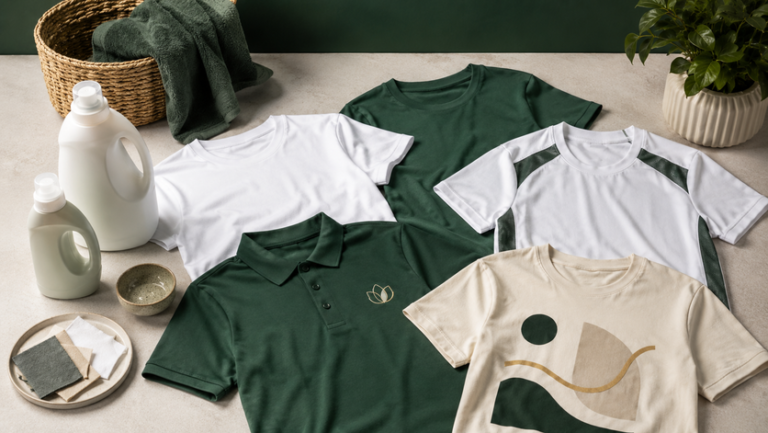
How to Decide Whether Bleach Is Appropriate
A safe laundry decision is easier when you check the garment in a consistent order instead of judging by colour alone.
Bleach Habits That Can Ruin a T-Shirt
Pouring concentrated bleach directly on fabric
This can cause immediate local colour loss or fibre damage. Add bleach only using the method stated on the product label or washing-machine dispenser.
Assuming every white shirt is bleach-safe
White garments may still contain spandex, coloured trims, print, embroidery or other components that require different care.
Using chlorine bleach on coloured shirts
Colour removal can happen unevenly and may be permanent. Use only a bleach type specifically allowed by the garment care label.
Mixing bleach with other cleaners
Bleach should never be mixed with ammonia, acids or other household cleaners because dangerous gases can form.
Ignoring print-care instructions
The shirt fabric may survive while the decoration fades or deteriorates. Custom apparel should be washed with the branding method in mind.
Using bleach for every stain
Many stains respond better to prompt rinsing, detergent, enzyme treatment or another targeted product. Stronger is not always better.
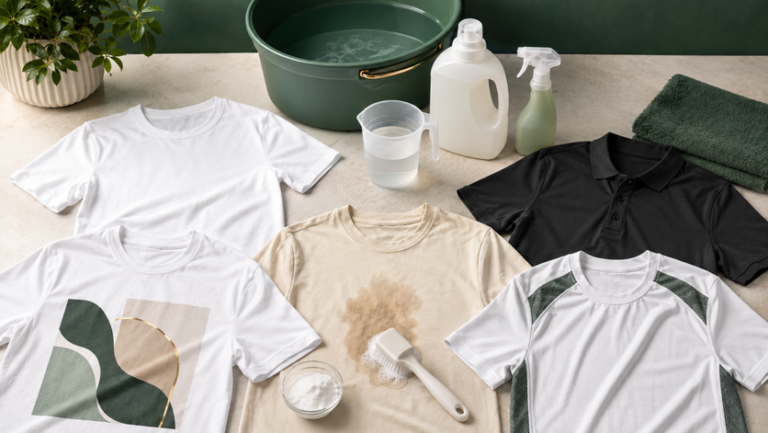
A Practical T-Shirt Washing Process Before Using Bleach
Use this sequence when a shirt is stained, dull or needs extra whitening. It reduces guesswork and keeps the care label at the centre of the decision.
Identify the shirt
Check colour, fibre content, care symbols and any custom print, embroidery, heat transfer, patch or elastic trim.
Identify the problem
Decide whether the issue is a local stain, general greying, odour, dye transfer or something else. Not every problem needs bleach.
Choose the permitted treatment
If the care label allows bleach, select the correct bleach type. If it allows only non-chlorine bleach, do not substitute chlorine bleach.
Test when required
For coloured or decorated items, follow the laundry product’s colourfastness test directions before treating the whole garment.
Measure and wash correctly
Use the product label dosage and the washer’s bleach dispenser or stated dilution method. Never pour full-strength bleach directly on clothing.
Inspect before drying
Check whether the stain is gone and whether the garment colour or decoration changed. Avoid repeating aggressive treatment automatically.
How This Applies to Common Uniform and Event Shirts
Plain white cotton used daily
If the label permits chlorine bleach and the garment has no bleach-sensitive trim or decoration, it may be suitable for occasional whitening. Use the exact laundry product directions.
Dark uniform with a printed logo
Chlorine bleach is a high-risk choice because it can remove dye. Use regular detergent or a permitted colour-safe product instead.
Microfiber shirt with DTF branding
Prioritise the garment and print-care instructions. Strong bleaching is rarely the best routine-care choice for a decorated performance tee.
Professional uniform with coloured thread
The shirt body may be white, but the embroidery still needs to be considered. Confirm colourfastness and the garment label before using bleach.
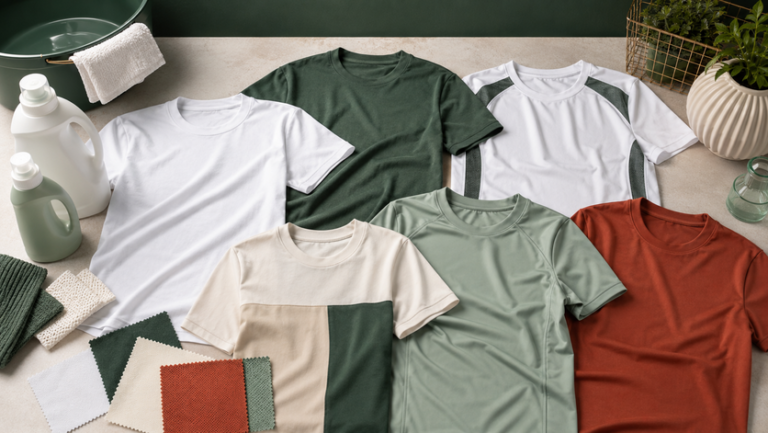
Before You Use Bleach on a T-Shirt
Run through these checks first, especially for company uniforms, sports shirts and custom-printed apparel.
- Read the garment care label.
- Confirm whether chlorine or non-chlorine bleach is allowed.
- Check the complete fibre content.
- Inspect prints, embroidery, trims and elastic.
- Test colourfastness when the product directions call for it.
- Measure the bleach according to the product label.
- Do not pour full-strength bleach directly onto the shirt.
- Never mix bleach with ammonia, acids or other cleaners.
- Use good ventilation and follow safety directions on the product.
- Choose a milder stain treatment when bleach is unnecessary.
Bleach and T-Shirt Care FAQ
Can I use chlorine bleach on a white T-shirt?
Can I use bleach on a coloured T-shirt?
What does the bleach symbol on a care label mean?
Can I pour bleach directly onto a stain?
Is oxygen bleach the same as chlorine bleach?
Can bleach damage DTF or heat-transfer prints?
Can I bleach embroidered shirts?
Can I mix bleach with detergent?
What should I use if the shirt says “do not bleach”?
How can companies make uniform care easier?
Choose Shirts That Are Easier for Your Team to Care For
Tell Uniform Sabah how the shirts will be worn, washed and branded. The team can help you compare garment types, fabrics and printing methods before you place the order.
Plan Your Next Shirt Order
Explore related pages for custom apparel, branding support and alternative uniform options.
Our Other Company Websites
Explore related uniform, apparel and custom-printing services through our regional and international websites.